

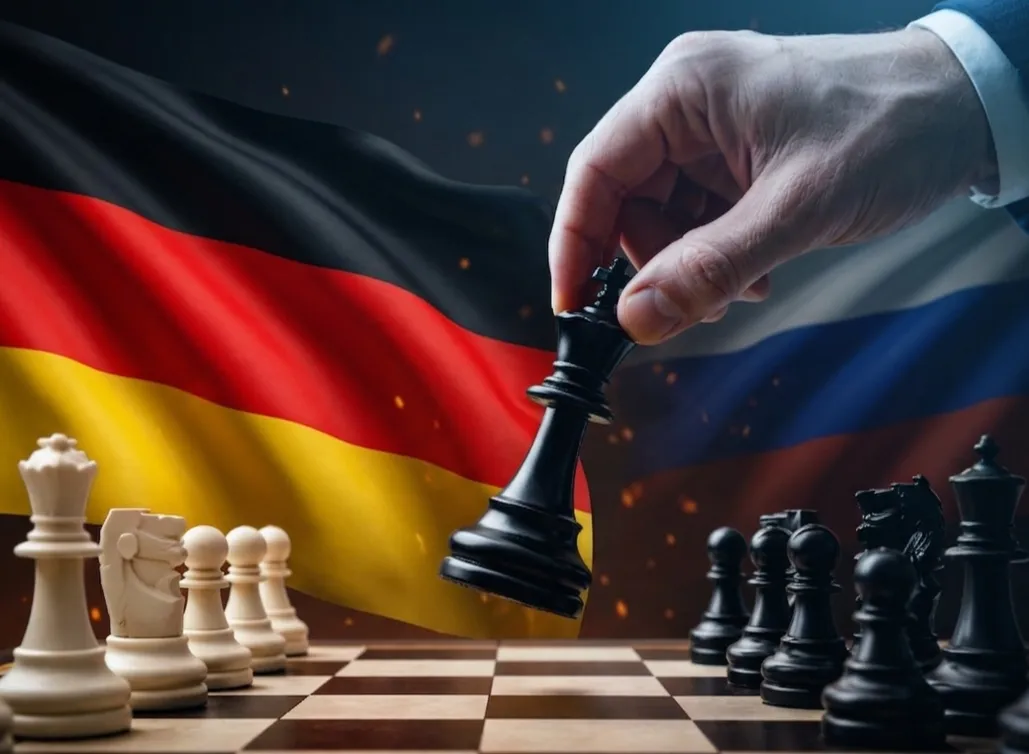
A little-known German company has poured millions into elite chess. Its partners, business ties, and global footprint are drawing increasing scrutiny.
After the ChessBase deal with Freedom Finance, another Germany-based story is beginning to raise questions.
In recent years, an unlikely name has emerged as a major financial force in the world of elite chess: WR Group Holding GmbH. Through its “WR Chess” brand, the company has funded major international events, partnered with FIDE, and assembled a superteam featuring some of the biggest names in the game.
Yet behind this rapid rise lies a more fundamental question: Where is the money coming from?
Because in modern chess, money rarely appears without a story behind it.
A Small Company With Huge Spending
On paper, WR Group does not look like a company that could be dominating global chess sponsorship.
It is a privately held German entity, with limited public financial transparency and no clear signs of large institutional investors, major bank financing, or stock market backing.
And yet, at the same time, it:
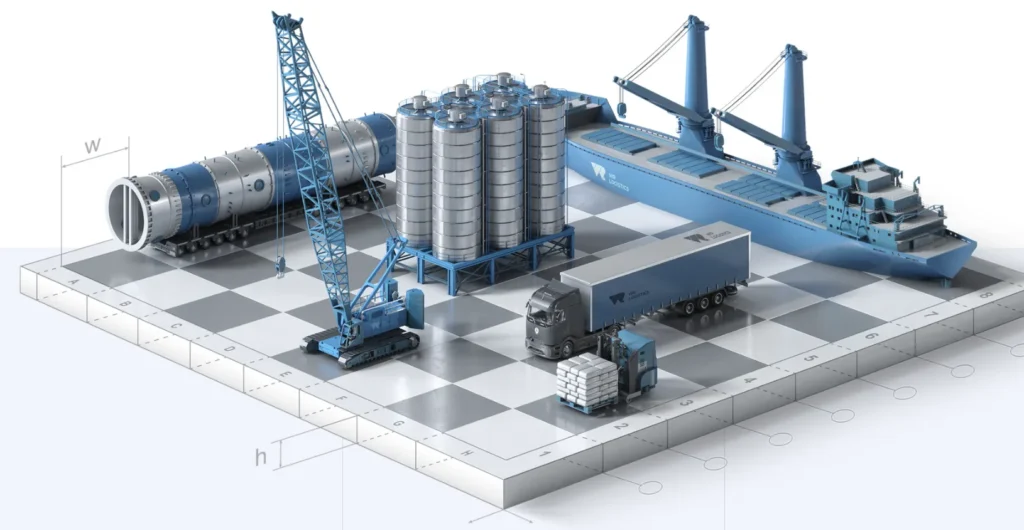
- Acquired INCO engineering s.r.o., an industrial player in mining infrastructure
- Expanded operations into logistics corridors across Europe, Asia, and the CIS region
- Continues to fund top-level chess events and elite teams
This mismatch between visible scale and visible spending is not necessarily unusual, but it does warrant scrutiny.
The Man Behind It
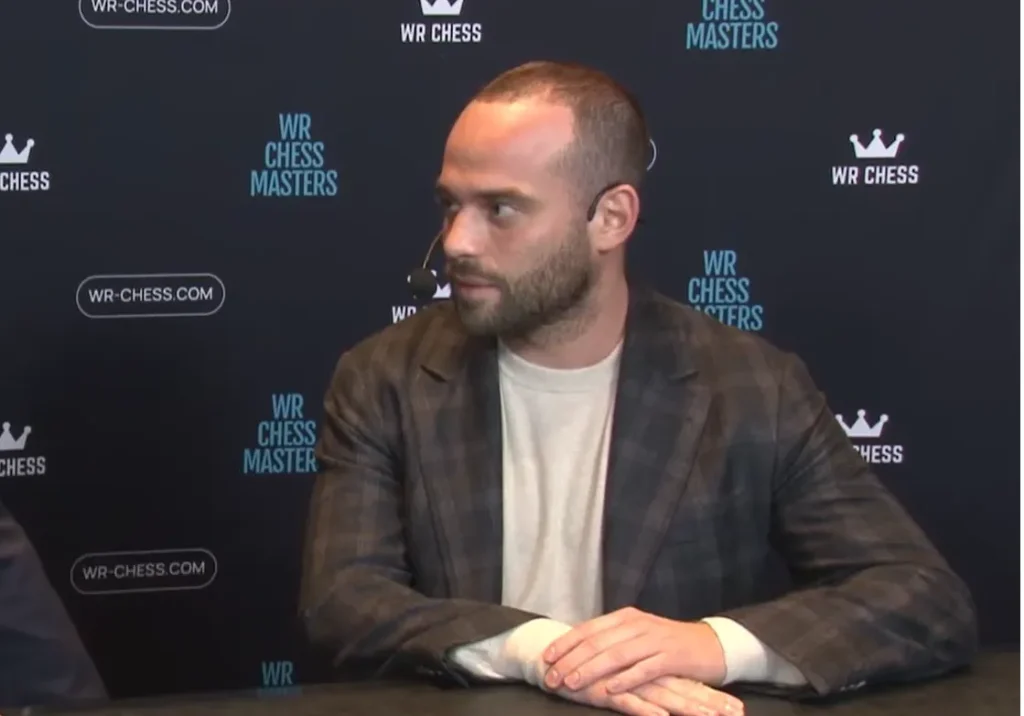
At the center of WR Group is its founder, Wadim Rosenstein.
Publicly, Rosenstein presents himself as a modern, globally minded entrepreneur – a businessman operating out of Germany, investing in logistics, engineering, and international projects.
He is also referred to as a “World Champion” following the creation of an unconventional format, the World Rapid Team Chess Championship, a competition created alongside initiatives closely connected to the WR Chess organization. In emerging sports formats, the line between innovation and self-positioning is often difficult to clearly define.
But a closer look raises additional questions.
Corporate records and business traces suggest that Rosenstein maintains business ties in Russia, including at least three active companies. According to available filings, one of them reports 2025 revenues of nearly €18 million, reflecting a year-on-year increase of approximately 136.8%.
Given the current sanctions environment, such performance is unusual and raises further questions about the underlying business dynamics.
It is also worth noting that in September 2022, at a time when Russia’s invasion of Ukraine was already well underway, Rosenstein appeared on the official Russian chess rating list. He later switched his federation to Germany ahead of WR’s major chess initiatives in 2023.
While federation changes are not uncommon in professional chess, the timing adds another layer to the broader questions surrounding positioning, identity, and international alignment.
The Geography
WR Group is not focusing its growth on traditional Western markets. Instead, its expansion points toward Azerbaijan, Uzbekistan, Central Asia and Latin America.
These regions form part of what is often referred to as the “Middle Corridor” – a logistics network connecting Europe and Asia while bypassing Russia directly, but remaining economically and historically intertwined with it.
This corridor has gained prominence since 2022 as companies seek alternative trade routes amid sanctions and geopolitical fragmentation. Critically, these markets maintain strong economic links with Russia and serve as hubs for indirect trade flows.
This does not prove anything on its own. But it places WR Group within a geopolitical grey zone where business, politics, and capital flows are rarely simple.
Chess as a Strategy
To understand WR’s moves, it helps to understand modern chess. At the highest level, chess is no longer just a sport. It is a networking and reputation-building (or washing) tool and a gateway into elite international circles.
Historically, the game has always had strong ties to power structures, especially in the Soviet and post-Soviet world. Today, that legacy continues in a new form: privately funded teams, corporate-backed tournaments, and wealthy individuals shaping the ecosystem behind the scenes.
In that context, WR Chess fits a recognizable pattern.
A German Shell or Something More?
One partnership, in particular, stands out.
In a public statement, Rosenstein described Glotech as a long-term supporter and key partner of his chess initiatives, emphasizing that the company has stood behind WR Chess “for many years” and shares its broader vision.
According to the same announcement, the two sides are jointly investing €250,000 into the development of chess events across Europe.
On the surface, this appears to be a standard sponsorship arrangement. However, publicly available information about Glotech raises a number of questions.
The company is registered in Germany, yet its ownership is associated with individuals identified as Russian nationals, including Evgeny Superfin and Evgeni Schukin.
Beyond basic registration data, Glotech maintains a limited public footprint. Its digital presence provides little clarity on the scope, scale, or nature of its operations, making it difficult to assess how the company generates the resources required for international sponsorship activity.
More notably, publicly reported information has linked individuals associated with the company to previous roles in state-linked industrial structures in Belarus, including senior positions in enterprises such as Minsk Kristal.
At the same time, external reporting has linked Glotech to shipments of telecommunications equipment to Russia in 2022, including deliveries that continued into the later part of the year.
While such activity does not in itself establish wrongdoing, it places the company within a category of businesses operating in areas that have attracted increasing regulatory scrutiny.
Connecting the Dots
Individually, none of these facts are extraordinary.
- A German-registered firm with foreign ownership.
- Business exposure to Russia or CIS markets.
- Private funding of international chess initiatives.
All are common in today’s global economy. But when these elements consistently appear within the same network, with the same partnerships, the same regions, the same strategic direction, the pattern becomes harder to ignore.
WR Group’s orbit appears to repeatedly intersect with:
- companies linked to Russian or CIS-origin ownership
- trade flows connected to Russia during a sanctions-heavy period
- regions that serve as alternative corridors between Europe and the East
At a minimum, this suggests a business ecosystem that is not purely Western in its structure, even if it presents itself as such. For some observers, it raises a more pointed question:
Is this simply a globally diversified network – or one that remains closely aligned, economically and structurally, with capital and relationships originating from the same geopolitical sphere?
The Missing Piece
None of this is evidence of wrongdoing. There is no public proof that WR Group has violated sanctions or engaged in illegal activity.
But there is also a noticeable lack of clear answers to some very basic questions:
- What are the primary sources of its capital?
- How are large sponsorship budgets structured and financed?
- How do its operations in Russia interact with current global restrictions?
- And why does a relatively low-profile company behave like a major global sponsor?
These are not accusations. They are simply questions that come with the territory when a company grows this fast, spends this much, and operates in this part of the world.
One More Question
There is, however, another question that is increasingly being raised in private conversations across the chess world.
How does a businessman with active companies across multiple countries find the time to be deeply involved, almost on a daily basis, in lobbying and positioning for leadership structures within FIDE?
Ambition in sport governance is nothing new. But when significant private funding, global business interests, and influence within a governing body begin to overlap, scrutiny tends to follow.
Signals From Within Europe
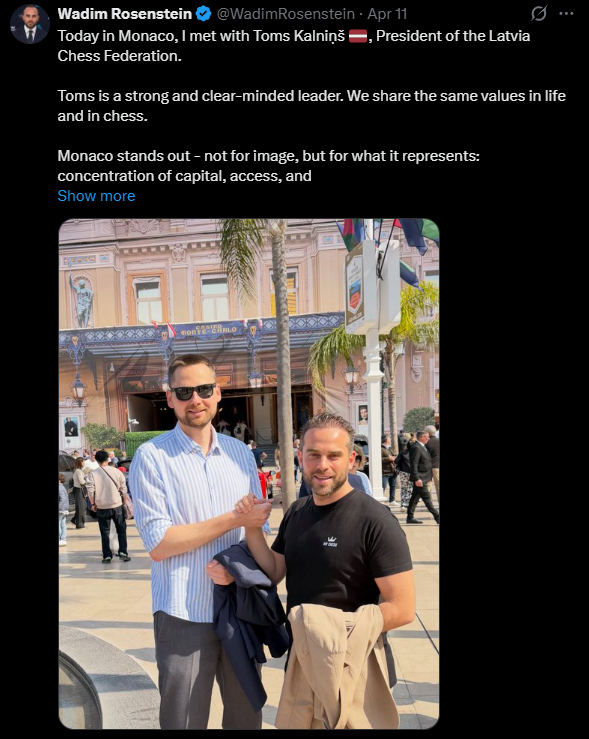
Recent public appearances also point toward developing relationships within European chess structures.
In April, Wadim Rosenstein shared a meeting in Monaco with Toms Kalniņš, a representative of the Latvian chess community, highlighting shared values and a common vision for the future of chess.
The Bigger Picture
WR Group’s rise in the chess world is real, rapid, and financially significant. It also signals a deeper shift in how influence within the sport is built, moving away from a federation-led structure toward one increasingly shaped by concentrated private capital operating across complex and often opaque geopolitical environments.
In today’s environment, structures that appear Western on paper are sometimes viewed by analysts as vehicles through which capital can remain globally active despite increasing regulatory and geopolitical constraints.
For many observers, this evolution raises legitimate concerns about transparency, governance, and the potential concentration of influence in the hands of a small number of privately funded actors.
Whether this represents a forward-looking model of global business integration, or a continuation of familiar power structures in a more modern and less visible form, remains an open question.
But in chess, as in business, appearances rarely tell the whole story.
And sometimes, the most important moves happen far away from the board.
[To be continued…]