

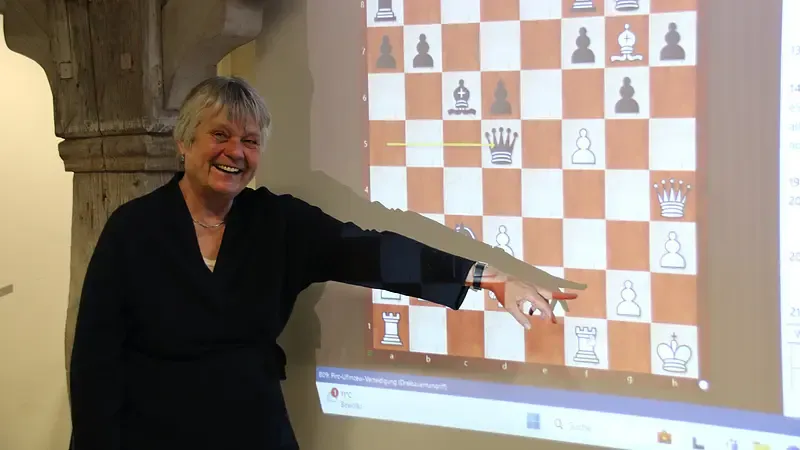
Meet WIM Ingrid Lauterbach! The first woman to lead the German Chess Federation in its 149-year-long history is no stranger to breaking barriers, having balanced a career in mathematics with elite international competition for two decades! However, her presidency now faces its most complex trial yet.
Speaking exclusively to Chess Topics, Lauterbach reflects on a storied career and her proudest achievements at the helm of the DSB, while issuing a stark warning regarding the internal polarization and Russian interference currently threatening the game’s stability.
Q1: You graduated in Mathematics from FAU, a field that much like chess at the time, was heavily male-dominated. How did your academic background shape your analytical approach to the game?
At that time, playing chess and studying mathematics was just supplementing each other, and I was enjoying both at the same time. Then, my diploma thesis was also in the field of game theory!
Q2: Looking back at your early days in chess, what were the biggest hurdles you faced as a woman trying to break into the professional scene? Do you feel those hurdles have changed for young girls today?
Several hurdles: you were often the only girl, with all pros and cons. You had fanatics who believed without any reason, you are their dream girl and therefore you had to try to get away as quickly as possible. There were an indefinite number of snappy stupid remarks, I think any female chess player now and then needs more resilience than an average person. I am worried that nowadays social media makes it even more easy to stalk someone, in my youth you could only send letters by mail, use landline phone or physical presence, nowadays you can reach everybody at any time with multiple channels.
Q3: You have represented both Germany and England in Chess Olympiads. How did this international experience influence your perspective on how a national federation should be managed?
First of all I enjoyed every single Olympiad a lot. For me in chess (but also in other aspects), I often compared England and Germany, and there is no clear winner. I love both countries and see them as my home. But I think a broader international perspective gives you always ideas and food for thought. The systems in the two federations are very different, in Germany the chess associations of the countries like Bavaria, North Rhine Westphalia, Hesse built the members of the federations, so we have 22 members. In England you have individual membership. In England every member decides on level of membership and pays their fee directly, in Germany the club members contribute via their clubs.
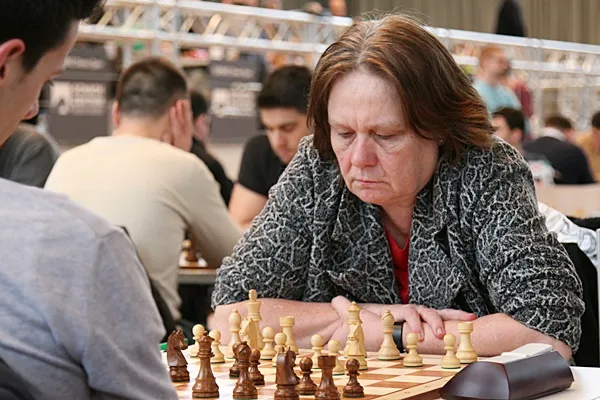
Q4: You are one of only two female presidents of national chess federations in Europe. Why is that number still so low in 2026, and do you feel you are held to a different standard than your male counterparts?
Chess is still a male dominated world, there are too many individuals who have still a problem with a women in a leading position. And whereas in the business world this is no longer an attitude which you can openly show, unfortunately, the chess world is way behind. However it is not only the attitude of male against female, there is also another aspect: if there is an open position, at least in the culture I grew up, it is much more likely that a man says, yes I want to have this position, whilst women tend to want to be asked and not to say, “I am the right person”. This is another reason why we are under represented.
Chess is still a male dominated world, there are too many individuals who have still a problem with a women in a leading position. And whereas in the business world this is no longer an attitude which you can openly show, unfortunately, the chess world is way behind.
Q5: You are the first woman ever to become the President of the German Chess Federation in its 149 year-long history! What has been your proudest achievement so far during your mandate as the President of the Deutscher Schachbund (DSB)?
The federation was in a difficult financial situation, when I started, With discipline I was able to solve this. In 2025, we organized one of the best German championship ever, and in 2026 we will have our huge chess summit with about 1000 players in Dresden, at the venue of the Olympiad 2008. This is all wonderful. But visiting competitions and root for the team, no matter if Olympiad or European team championship, is also always special.
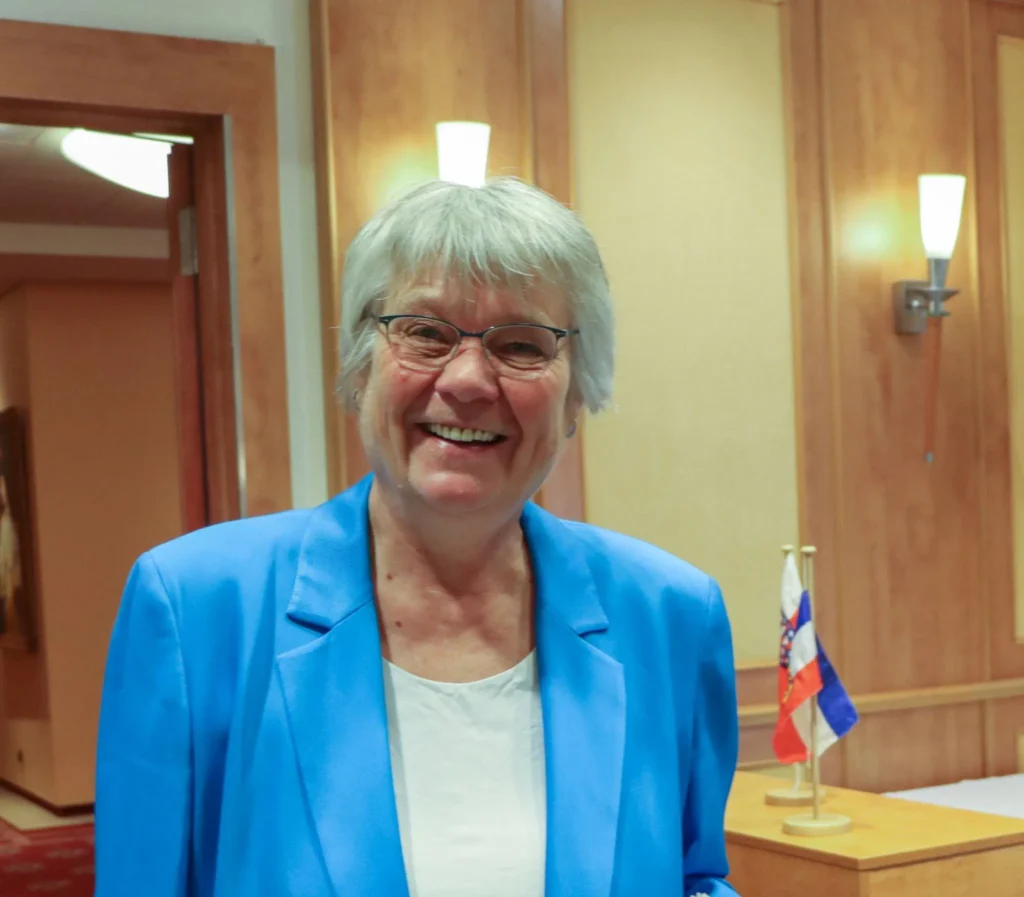
Q6: There has been some discussion in the media regarding internal DSB dynamics. The DSB has recently been described as being ‘at war’ with itself, especially following the rejection of the Congress request and the escalation of internal disputes. Would you be eager to tell us more about the current situation in the German Chess Federation? And in the interest of transparency and moving forward, how would you describe the current path to resolution?
It is true, that despite all the success we had in different areas, the current image of internal matters is worrying. Unfortunately there is a history that instead of working constructively in the interest of chess, a lot of vanity is displayed. In regard to the decision about assembly or not, there were different views from different lawyers (also from outside the chess world), but a decision of the court of arbitration has to be respected.
Generally I am worried about the misuse of social media to publish incorrect information as facts. As board, there is often limited possibility to react. In certain cases, like staff issues, it is legally forbidden. However it makes also no sense to sue everybody for slander, even if this would be legally appropriate, or to react to blackmailing. At the same time, we see at different levels in chess (as well as in other sports), the attempts where Russian influence tries to undermine us. I think we all need to stay alert, we need to stick to our values, but need to openly discuss with each other (and not via social media) what needs to be addressed. We should not talk about each other, but with each other.
At the same time we see at different levels in chess (as well as in other sports), the attempts where Russian influence tries to undermine us. I think we all need to stay alert, we need to stick to our values.
Editor’s Note: Chess Topics is currently investigating reports of Russian interference within the DSB and the wider international chess community. A full exposé on our findings is forthcoming.
Q7: How do you respond to critics who claim that the federation’s leadership is becoming too centralized?
I am not sure that I understand the question. In the last years, we had a board of four members, and in May 2025, I had suggested to get an additional Vice President specialized for IT, digitalization and security. Unfortunately we did not get the necessary majority of 2/3 of the votes, but I would have preferred a board of 5.
Q8: In such a polarized environment, how do you maintain the focus on the players and the development of chess in Germany?
I am fact orientated and I act professionally – this is my own minimum requirement for myself. I am certainly irritated about these negative campaigns. And there is also a lot of disappointment about some of these self-declared advisors of German chess federation, who have no clue, but feel so important, to let everybody know what has to happen. But as long as I am in this function, I do what is my job and what needs to be done, I think this can be expected from me.
There is a lot of disappointment about some of these self-declared advisors of German chess federation, who have no clue, but feel so important, to let everybody know what has to happen.
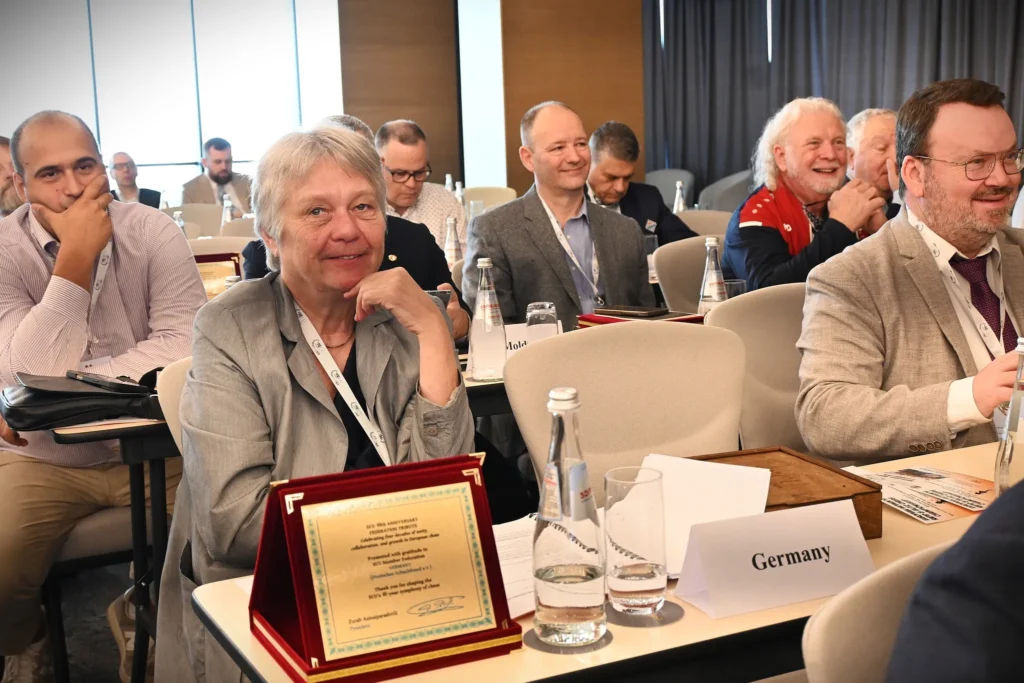
Q9: You are a candidate for a position within the European Chess Union (ECU). How did you become the part of the team and what is the core mission you are bringing to the European stage? Do you believe that this role can help making the bridge between German and European chess interests?
I said before, women want to get asked (smiles), and that is what happened! Germany is an important federation in Europe, and I think we should be appropriately represented. As a person, I believe in Europe, and that it is important that we bridge with all federations, sharing our values and make chess in Europe and the world even bigger.
Q10: Your career represents a complete journey through the chess world. What is your message to women who aspire to follow in your footsteps, not just as players, but as arbiters, coaches, organizers, and eventually leaders in chess administration? How can they turn their passion for the game into a lifelong professional path?
Never give up, believe in yourself, ignore if someone wants to belittle you. The majority of chess players is nevertheless supporting! If you need help, ask for it, and it will work! Ignore the destructive and negative figures, they are not worth to be even considered!
Never give up, believe in yourself, ignore if someone wants to belittle you. The majority of chess players is nevertheless supporting!