

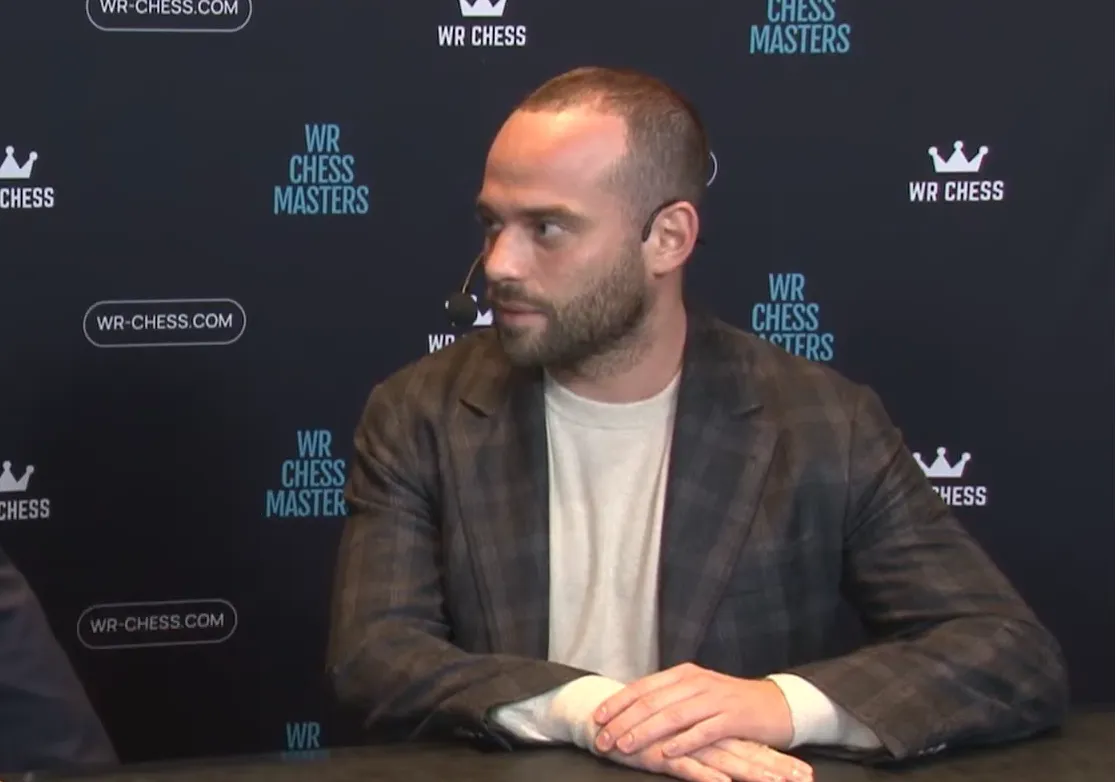
When the votes were counted at the European Chess Union General Assembly in Bucharest, one result stood out above all others. The ticket led by Bachar Kouatly, the political project backed and financed by WR Chess founder Wadim Rosenstein, received just seven votes out of fifty-three.
For a campaign seeking to convince the chess world that it is ready to lead FIDE, the outcome was far more than an ordinary electoral defeat. It raised a broader question that will now follow Rosenstein all the way to the FIDE General Assembly in Samarkand: can enormous financial investment in elite chess be transformed into genuine political support among national federations?
The answer delivered by European delegates was unequivocal. Zurab Azmaiparashvili’s ticket secured a comfortable victory with 35 votes, while Łukasz Turlej received 11. Kouatly’s ticket finished a distant third with only seven votes, barely thirteen percent of all ballots cast. Regardless of how much money and effort had been invested in the campaign, the result exposed a significant gap between visibility and political credibility.
A Short Political Résumé
Rosenstein’s campaign has largely been built around the argument that his investment in chess has earned him the credibility to lead its governing body. Yet one aspect of that narrative deserves closer examination: his public involvement in international chess is remarkably recent.
Prior to 2022, Rosenstein had virtually no visible role in international chess. His first widely noticed appearance came alongside Sergey Karjakin at a time when the Russian grandmaster had been suspended by FIDE after publicly supporting Russia’s invasion of Ukraine. Rosenstein himself has never publicly stated his position regarding the invasion, despite becoming an increasingly prominent figure in international chess over the following years.
Since then, WR Chess has invested substantial financial resources into elite tournaments and high-profile events. That financial commitment is undeniable. What remains unproven is whether several years of sponsorship can substitute for the federation work, relationship-building, and institutional experience that have traditionally defined successful leadership within international sports organizations.
The Bucharest vote suggests that many European federations do not believe that transition has yet taken place.
Sponsorship Is Not the Same as Leadership
There is little doubt that private investment has benefited elite chess. Prize funds have increased, prestigious tournaments have been organized, and top players have enjoyed new competitive opportunities. Those achievements, however, should not be confused with the responsibilities of governing an international federation.
FIDE is not an event management company. It represents nearly two hundred national federations with vastly different priorities, financial realities, and political interests. Many of them are concerned less with elite invitationals than with youth development, coaching, arbiters, grassroots funding, continental cooperation, and long-term institutional stability.
Winning their confidence requires more than financial resources. It requires diplomacy, compromise, and personal relationships. Those qualities are difficult to acquire quickly, regardless of the scale of one’s investment.
The Burden of Two Presidencies
Only one day before the ECU election, Rosenstein proudly announced another achievement on social media: “Today, I was elected President of the European Federation of Mixed Martial Arts.”
Congratulations are certainly in order. Yet the announcement also raises a legitimate question that FIDE delegates are likely to consider.
The presidency of FIDE is widely regarded as a demanding, full-time international responsibility. It involves constant travel, negotiations with nearly two hundred national federations, engagement with sponsors and international institutions, oversight of world championships, and continuous management of one of the largest international sports federations.
Delegates may reasonably ask whether one person can devote the necessary time, energy, and attention to leading two international sports organizations simultaneously. Holding both positions is not impossible, but it inevitably invites scrutiny at a time when Rosenstein is asking federations to entrust him with the highest office in world chess.
The Political Contrast
The aftermath of the Bucharest election highlighted another challenge for Rosenstein’s campaign. Jan Henric Buettner, together with Malcolm Pein, moved quickly to align himself with Zurab Azmaiparashvili’s victorious coalition. More importantly, Buettner publicly invited both Rosenstein’s supporters and WR Chess to cooperate within the existing FIDE framework.
Whether intentional or not, the message subtly reframed Rosenstein’s role. Rather than treating him primarily as a rival for the FIDE presidency, Buettner presented WR Chess as a valuable commercial partner whose contribution could continue within FIDE’s existing institutional structure. It was a reminder that political influence is not measured solely by financial investment but also by the ability to build broad coalitions.
Why Bucharest Matters
Some observers may argue that the ECU election has little bearing on the upcoming FIDE presidential race. That would underestimate its political significance.
Europe contains many of the federations most familiar with WR Chess and with Rosenstein’s activities over the past several years. If those delegates were not persuaded to support the political project most closely associated with him, it becomes more difficult to convince federations elsewhere that his candidacy represents a broad international consensus.
Momentum matters in international federation politics. Delegates naturally look for candidates capable of assembling winning coalitions. A seven-vote result does not make victory in Samarkand impossible, but it undoubtedly makes the road considerably steeper.
The Verdict
None of this diminishes the fact that private investment has become an important part of modern chess. Sponsors are essential, and elite tournaments benefit from substantial financial backing. The question before FIDE delegates, however, is not whether Wadim Rosenstein has spent money on chess. It is whether he has demonstrated the political experience, institutional judgment, and international trust required to lead the global governing body of the sport.
The Bucharest election suggests that many European federations remain unconvinced. Seven votes will not decide the FIDE presidential election on their own, but they do reveal an uncomfortable reality for Rosenstein’s campaign. Financial resources can create visibility, organize prestigious tournaments, and generate headlines. Building political legitimacy among national federations is a very different challenge, and one that cannot be solved by investment alone.