

As the 2026 European Chess Union (ECU) elections approach, serious questions are being raised regarding the ticket headed by Lukasz Turlej, the current Secretary General of FIDE and a contracted member of the FIDE Management Board.
By seeking election as ECU President, Mr. Turlej is not merely running for a continental office. Under FIDE regulations, Continental Presidents also become members of the FIDE Council, the body responsible for overseeing the work of the FIDE Management Board.

The candidacy has sparked widespread concern about a potentially unprecedented governance situation. Mr. Turlej currently serves as a contracted FIDE executive while simultaneously seeking election to a body that exercises oversight responsibilities over the institution in which he is employed.
Opponents argue that such a situation risks creating conflicts of interest and undermining confidence in the neutrality of the electoral process.
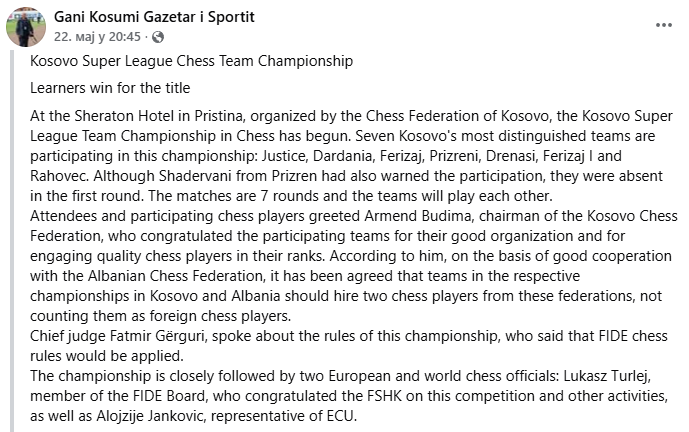
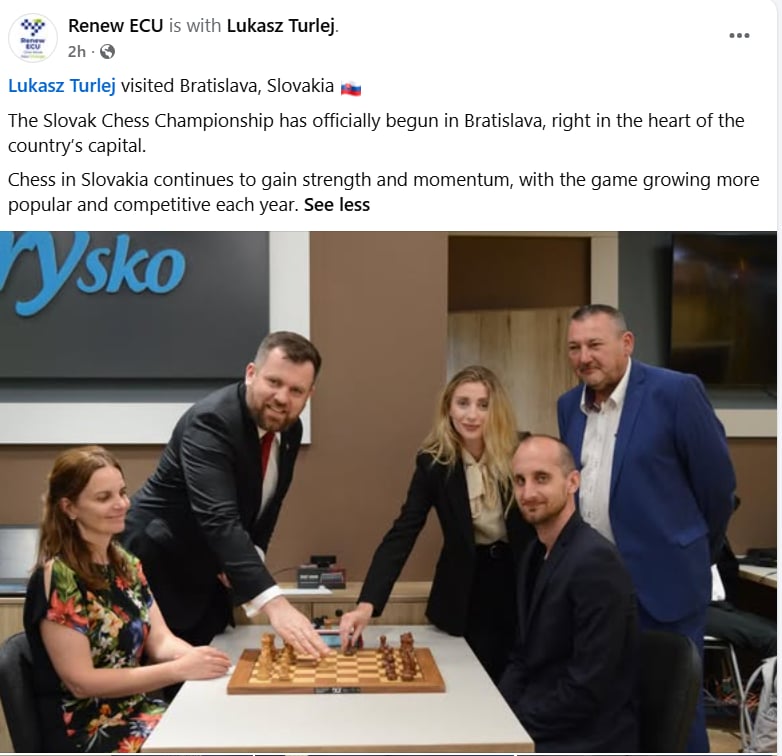
Mr. Turlej has responded by stating that he would refrain from acting as FIDE’s representative in Europe during the election period. However, as evidenced by publicly available posts, Mr. Turlej’s visits to Kosovo and especially Slovakia suggest a discrepancy between how the trips were presented publicly and how they were described in campaign communications. At events, he was introduced as FIDE Secretary General and appeared in his official capacity, whereas campaign messages portrayed the visits primarily as part of his ECU election effort, while concealing his role within FIDE.
During the election period, Mr. Turlej has not limited himself to acting in his capacity as FIDE Secretary General. He has also continued to hold prominent lucrative positions at major FIDE events, including the World Team Rapid Chess Championship in Hong Kong, where he currently serves as Tournament Director.
The matter is particularly significant because debates regarding the political neutrality of FIDE employees have existed for years. Concerns have been raised on numerous occasions about whether staff members should be involved in election campaigns at all. The current situation goes even further, as a contracted FIDE executive is himself seeking election to the FIDE Council while continuing to perform paid duties within FIDE.
Some observers argue that allowing such a precedent could enable future FIDE administrations to place employees or contractors on electoral tickets across different continents, potentially weakening the independence of elected officials. If this principle is accepted, where would the line be drawn? Could future FIDE presidential tickets themselves be composed of serving employees and contracted members of the FIDE Management Board?

Photo from the FIDE World Cup Goa 2025 where months prior the ECU elections period, the members of the Lukasz Turlej’s ticket had official positions for the FIDE World Chess Cup and FIDE World Corporate Chess Championship which simultaneously took place in Goa, India; [Photo by FIDE/ Michal Walusza]
The issue has also drawn attention to provisions within the FIDE Code of Ethics and Electoral Rules. The Code of Ethics defines FIDE employees as:
“Directors and other FIDE staff members rendering remunerated services to FIDE in terms of a service contract.”
The FIDE Electoral Rules (9.8) further state:
“No candidate should coerce FIDE employees, officials, advisors or others to work on his/her behalf.”
They also provide that:
“The members of FIDE Offices should limit their relations with the candidates strictly to the content of their role as staff.”
Turlej’s candidacy therefore raises governance and ethical questions that merit careful consideration by the FIDE Ethics Commission, the FIDE Electoral Commission, and ECU delegates.
The concerns surrounding Mr. Turlej’s ticket do not end there.
Another member of the ticket, Alojzije Janković, who is seeking election as ECU Secretary General, is currently facing serious allegations in his home country. More on this soon.